
Epstein's Six Types of Family Involvement: The Framework That Named What I Already Knew
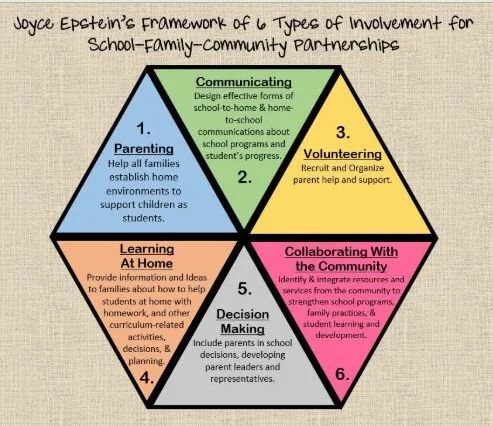
Diagram of Epstein's Six Types of Family Involvement. Image via School Leadership 2.0 (schoolleadership20.com).
Dancing Panda helps schools make family engagement simple, joyful, and connected to classroom learning. In this post, our founder Deb shares the conference moment that gave her years of family engagement work a name — and introduces the classic framework every education leader should know.
I've spent years in schools. And it took one slide — shown for five seconds — to change everything.
I've worked as a K-3 school leader in Harlem, in a district role supporting school leaders on family engagement strategy, and as a parent and community member myself. I thought I knew this space well.
Then I walked into a session at NAFSCE (National Association for Family, School, and Community Engagement) annual conference and saw a single slide flash on screen: Epstein's Six Types of Family Involvement. The presenter moved past it in seconds. I nearly fell out of my chair.
What I didn't know then — it's considered the classic, go-to framework in the field. I'm a practitioner at heart. I live in the doing. But building Dancing Panda has pushed me to go deeper into the research — and moments like this remind me why that matters.
Everything I'd experienced — the PTAs, the parent nights, the chronic absenteeism conversations, the Title I puzzle pieces — suddenly had a home. A framework. A language.
That one slide didn't teach me anything new. It helped me finally name what I already knew. It's also the lens through which I built Dancing Panda — because every school deserves a clear map for engaging families.
I know Epstein's framework has its critics (where's the equity lens? still noodling on that).
But for me, it was a gift.
Deb shares thinking like this regularly on LinkedIn — connect with her there.
